Are you enjoying this trip through the Mathabet as much as I am?
If so, you might like to check out the book I’m writing about it as a companion to this season of the podcast. It’s due out in a couple of weeks and I am so excited for you to get your hands on it! The book takes you through what I am calling the Mathabet, one letter at a time. In it I share a few mathematical ideas beginning with each along with where you might encounter them and some insight as to when interacting with an idea might not seem like math.
If you’d like to be the first to know when it’s available, head on over to onamission.bio/jennifermasonhardin to “Meet me in your inbox.” If you already get podcast updates from me by email, you are already on the list.
{This is a modified transcript for Episode 48 of the I See Math People podcast. To listen instead, click here.}
Let’s move on to today’s topic…mathematical ideas beginning with the letter T. What is the first thing that comes to your mind?
Time
Time is a man-made system for keeping everyone on the same page. We’ve created time zones to even out our distribution around the world so everyone’s day begins with the morning sun and ends with nightfall. We’ve created a 24 hour system that tracks the Earth’s rotation on its axis and allows us to show up to events at the same time.
We used to mark time with analog clocks, where telling time involves reading the hand positions as they move around a circle. Do you still have one of these? More common now is the digital version, where the numbers just change on their own to track time and all we have to do is read the numbers instead of thinking about the hands. Even with digital clocks, though, we have to understand the concept of our time system in order for the numbers to have meaning.
I know you check the time frequently throughout your day. You check it to see how much time is left in your work day, to know when to get ready to head to soccer practice, to gauge how quickly you need to drive to make it to your appointment. You set alarms based on when you need to wake up or start dinner and you keep a close eye on the game clock, wondering if your team has enough time to pull off the win.
Believe it or not, many of these time checking practices involve a word that belongs at the beginning of the Mathabet. One you probably learned to hate. That word is algebra. {Cue the groans.} You don’t want to believe it because you thought you’d never use algebra ever again after that last math class, but you use algebraic thinking all the time and interacting with the concept of telling time involves a lot of it.
So, the next time you glance at your watch to check how much time the cookies still need to stay in the oven, remind yourself that time is a mathematical idea and your interaction with it makes you a math person.
Tables
A table is another idea beginning with T. I’m not talking about your dining table or your coffee table here, of course. I’m talking about a grid-like chart you use to organize information.
A spreadsheet is a table. So is the arrival and departure information board at the airport. And guess what else is a table? Your calendar. So don’t even try to tell me you don’t interact with them. Or that you aren’t a math person.
Triangle
We briefly mentioned triangles in the last episode, when we talked about shapes. Of course you know a triangle is a basic shape whose primary characteristic is that it is made up of three straight sides. Depending on the angle measures and side lengths, there are several different kinds of triangles…right, isosceles, and equilateral are three that come to mind. You notice and create triangles even if you aren’t consciously aware you do. You create triangular spaces in your landscaping, place furniture catty-corner in a room, and cut your sandwich on the diagonal.
Tally Marks
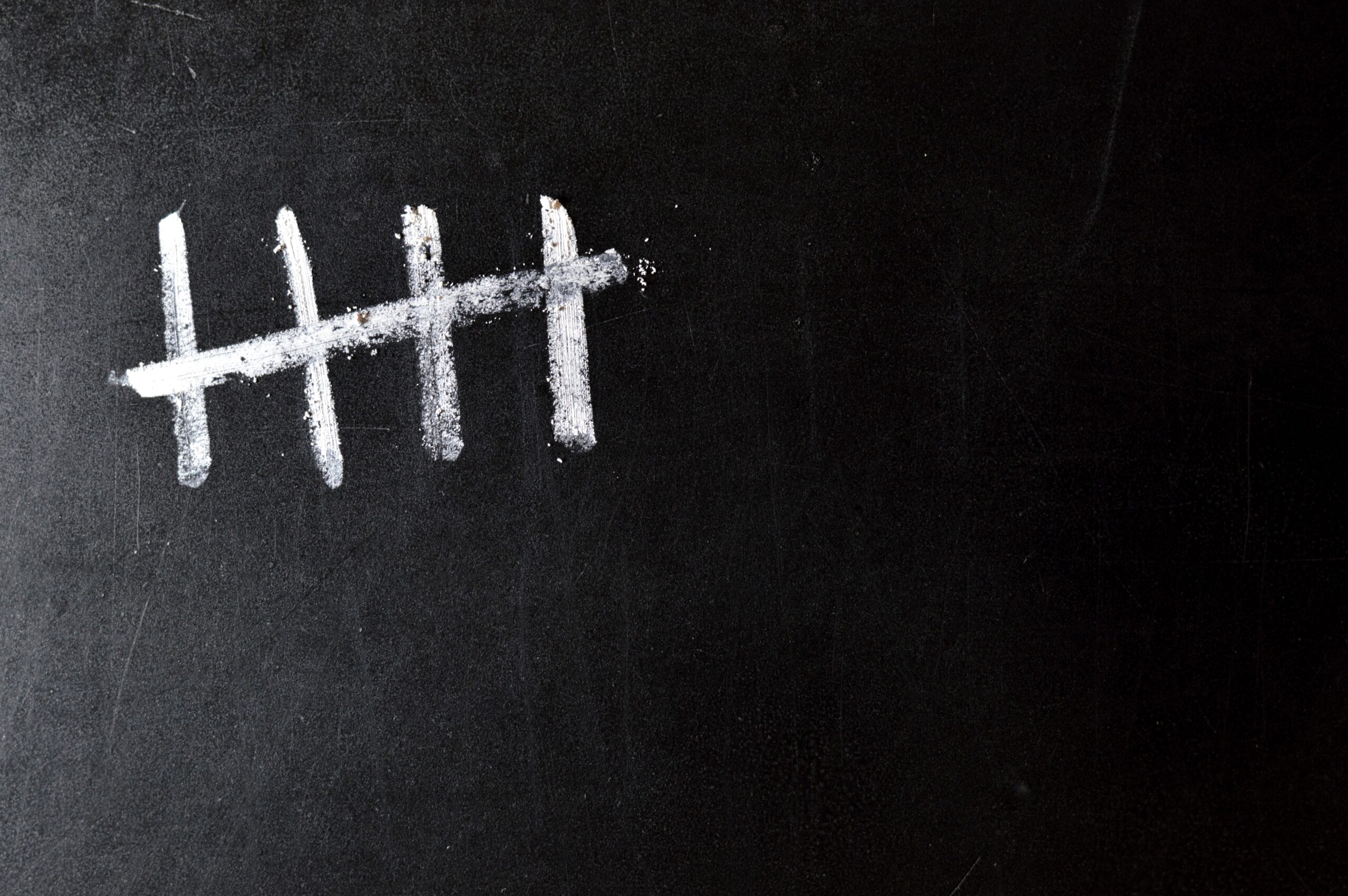
Tally marks are used to keep track of the frequency or quantity of something. We usually make a mark that looks like a 1 for each item and every 5th mark crosses the others to make a group of 5. This convention makes it easier to count large numbers of tallies accurately. I don’t find myself using tally marks frequently, certainly not daily, and you might not either, but I know you are familiar with them and use this idea when needed. And that makes you a math person.
Tessellation
One mathematical term you might not be familiar with, but you recognize when you see it, is tessellation. A tessellation is a repeating pattern made up of one or more shapes. When you tile your bathroom floor with square tiles, you are tessellating those tiles. Using squares of uniform size is easy, because they fit together right next to each other. You might use squares of different sizes to create your floor pattern, too. Or you can use a combination of squares and rectangles or completely different shapes altogether if you want your design to be more intricate. The only rules are that the pieces must fit together without gaps and shapes cannot overlap.
Where else do you see tessellations? Bricks on a house or a wall tessellate. So do kernels of corn on the cob and squares on that quilt your grandmother made.
The next time you are tiling a fireplace or your shower wall, or putting together a jigsaw puzzle, take a moment to appreciate the beauty of tessellations and celebrate that this makes you a math person.
I’m so grateful you joined the conversation today! I’m on a mission to change the way the world sees math, starting with you. If you found value in this post, if something you read made you pause, or if you suddenly realized the hidden math in something you do every day, now is the time to join the movement!
When you comment here and share this site, or when you subscribe to, rate, and share the I See Math People podcast, the algorithms will show it to more people and the more people who get the message, the more mindsets can begin to shift.
Thank you for being part of this discussion of a few of the mathematical concepts beginning with the letter T. I truly hope you heard something about time, tables, triangles, tally marks, and tessellations you can relate to and that it made you stop and think about where math shows up for you on a daily basis. Noticing where you interact with math is the first step to beginning your mindset shift and seeing yourself as the math person you really are.
I’m Jennifer Mason Hardin and everywhere I look I see math people just like you.