I’ve already shared with you some ways patterns show up in nature, both visual patterns and number patterns, like the Fibonacci sequence in some previous episodes. In today’s discussion, I want to focus on how symmetry, an important mathematical concept, shows up in the great outdoors.
There are a few different kinds of symmetry out there in the world, and you may remember some of them from math class or even from art class. When you were learning about shapes, were you ever asked to fold them in half? Like how you can fold a square in half and end up with two smaller rectangles, or with two triangles, depending on where you make the crease. Or maybe you finger-paint on one half of a piece of paper and your teacher folded it in half so when you opened it back up you had a mirror image of your design. In algebra class, you may remember how a parabola has an axis of symmetry, meaning it has a line that runs through it and creates two equal halves.
These are examples of what we call bilateral symmetry, meaning there’s one line we can draw down the middle that creates two nearly identical halves that are mirror images of each other. Can you think of some examples where we see this in nature? One of the first things I think of is a leaf.
When you look at an oak leaf or a maple leaf or a poplar leaf or any number of other types of tree leaves, you see a line down the middle of it that connects the farthest point on the outside edge of that leaf to its stem. When you fold the leaf along this line, you get two halves that are almost identical. The same kind of thing applies to the faces and bodies of animals.
If you draw an imaginary line from the tip of the nose to the tip of the tail of an animal, that line will create two halves that are nearly identical. Have you ever watched a butterfly sitting on a flower and notice the pattern of its wings? How the pattern is the same on each side of its body, and when the butterfly brings its wings together, it looks like one single wing?
This is another example of bilateral symmetry. Take a look outside and see where else you can find this kind of symmetry.
Another type of symmetry is rotational or radial symmetry.
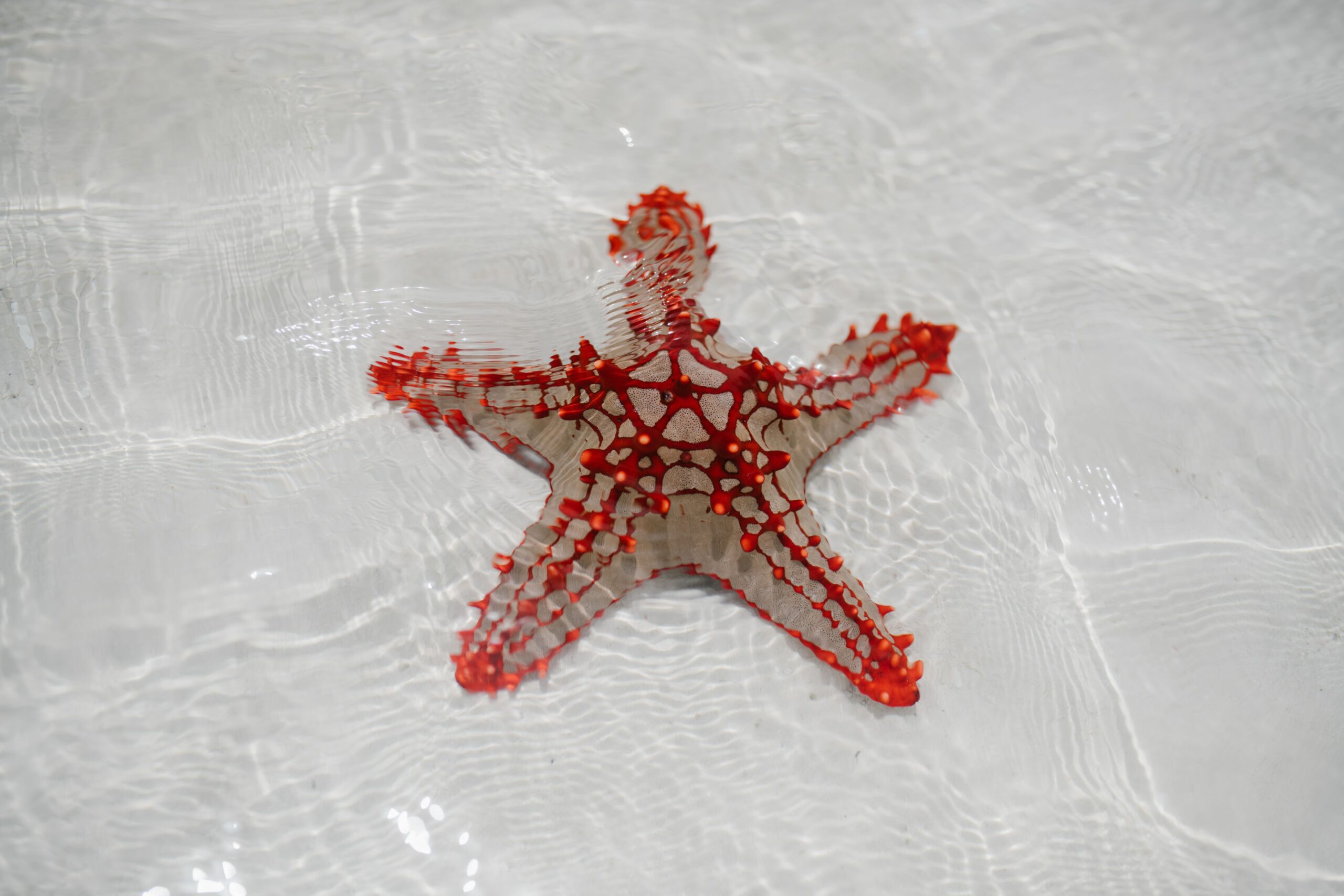
This happens when there is a central point from where similar things grow. Like in a starfish, for example. Starfish have arms that radiate outward from a single point. That’s radial symmetry.
And when you rotate the starfish a certain number of degrees around that central point, it will look the same. That’s rotational symmetry.
Some flowers, like daisies, are another example of this kind of symmetry. The petals radiate outward from a central point, and if you rotate the bloom around that point, the flower looks the same. Can you find other examples of rotational or radial symmetry when you step into your yard?
Another kind of symmetry you might find in nature is spiral symmetry. This involves a repeating pattern that winds around a central axis or a central line, like a pole, and also extends or grows outward along the length of that line. Some seashells have this kind of symmetry, and pinecones are another example of this.
Pinecones actually have a double spiral going on, one growing in each direction around the axis. Another example of spiral symmetry that you might be familiar with is the way scales cover the outside of a pineapple.
Symmetry is everywhere in nature.
Where do you notice it when you go outside? I would love to hear all about your discoveries and even see some photos. Be sure to email me them at je******@************pi.com.
Whether it’s hiking, walking on the beach, or even just sitting on the deck, looking at my backyard. I’m very curious about the world around me, and I love noticing patterns and wondering where else they show up. There is so much to discover, and I see something new every time.
Is this true for you too? If so, you are definitely a math person.