Since I started the podcast a few months ago, most of the episodes I’ve recorded (and the posts I’ve made here to accompany them) so far either focus on a specific mathematical idea you frequently use, sometimes without even realizing it, OR on the math involved in a particular activity you do on a regular basis. There’s a few other topics, like growth mindset and some of my back story thrown in there, but this post is a bit different.
Today I’m talking about some of the wonderfully fascinating ways math shows up in the great outdoors. Whether this idea is brand new to you or you’ve heard some of it before, I hope this episode sparks something in you that makes you take notice next time you are out adventuring or just in your own backyard. You might even be inspired to travel down the internet search rabbit hole if something catches your interest.
Before we really start talking about the math we see in nature, can we just take a moment to appreciate the abundance of everything outside? When I go outside, even just in my own yard, I see more blades of grass and more leaves on the trees than I can count.
Just a short drive away from where I live is a national forest, with trees, rocks, rivers, lakes, and wildlife…from the tiniest of insects all the way up to bears. Yes, we have bears around here…they sometimes venture into town and once or twice I’ve even seen them in my neighborhood. No matter where I look, there is abundance and I’m just in awe of what we have here on this earth. Do you ever feel that way, too?
I guess if you want to get technical about it, infinity is a mathematical idea, so when you notice the countless grains of sand on the beach or water droplets in a river or the infiniteness of the sky, you are using your math brain a bit.
Moving on to some ideas that are a little less theoretical and still awe inspiring…
One of my favorites, maybe it’s a favorite because it’s pretty well known, or maybe because it really fascinates me, is Fibonacci’s Sequence. Fibonacci was a medieval era mathematician who is credited with introducing a few mathematical ideas to Europe, including the sequence that is now named for him. Fibonacci’s Sequence begins with 1 and continues by adding the two previous numbers in the sequence to get the next number. The first several are 1, 1, 2, 3, 5, 8, 13, 21, 34 and 55…and this sequence continues for as long as you keep adding to it.
This just seems like a fun thing to think about until you step outside and start noticing things like pine cones or how sunflower seeds grow or the number of petals on flowers. Fibonacci Sequence numbers keep showing up over and over again in nature. In fact, as I was preparing to record the podcast episode on this topic, I was outside on my deck and I started counting the petals on the blooms in the containers I have out there. Every variety I counted has a Fibonacci number of petals. Fascinating, right?
Something else that keeps showing up and that is closely related to the Fibonacci Sequence is the Golden Spiral. Imagine this…or draw it out on a piece of paper as I’m describing it. Start with a square whose side length is 1 cm. Now, using one of the sides as the side of a new square, draw another 1 cm square. This gives you a rectangle that is 1 cm wide and 2 cm long. Now, use the long side of that rectangle as one side of another square with 2 cm sides. This gives you a new rectangle that is 2 cm wide and 3 cm long. Now use the long side of this rectangle as a side of another square that has 3 cm sides. This gives you another rectangle, this time with a width of 3 and a length of 5. Are you following? If you are having trouble visualizing or drawing, it looks kind of like this:
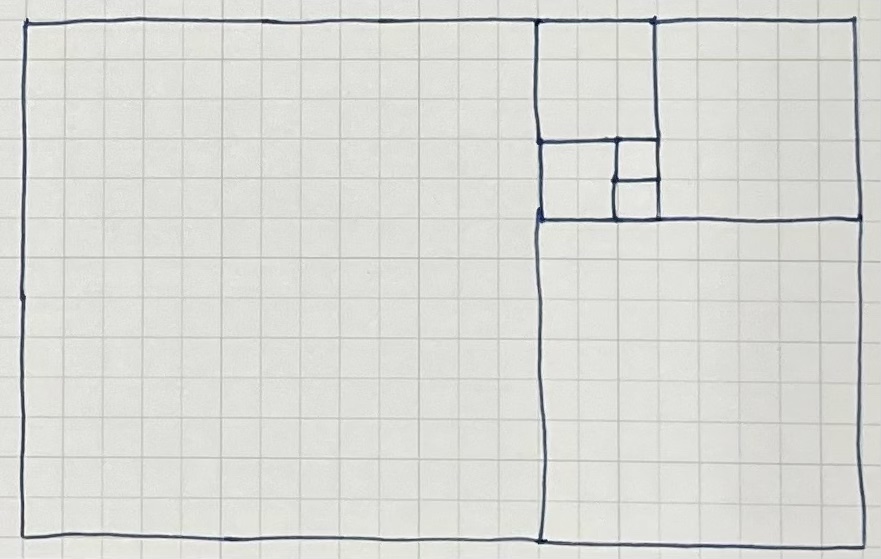
Keep using the long side of each new rectangle as a side of an additional square and a couple of fun things start happening…one, each new rectangle has dimensions equal to two consecutive Fibonacci numbers. We’ll come back to this idea in a few minutes. And, two, if you begin at one corner of the smallest square and draw an arc through the opposite corner that continues diagonally through each square as it comes in the sequence, you’ll get a beautiful spiral, called the Golden Spiral. My artistic ability only goes so far, so I’ll leave you to discover this on your own. A quick internet search will show you lots of possibilities.
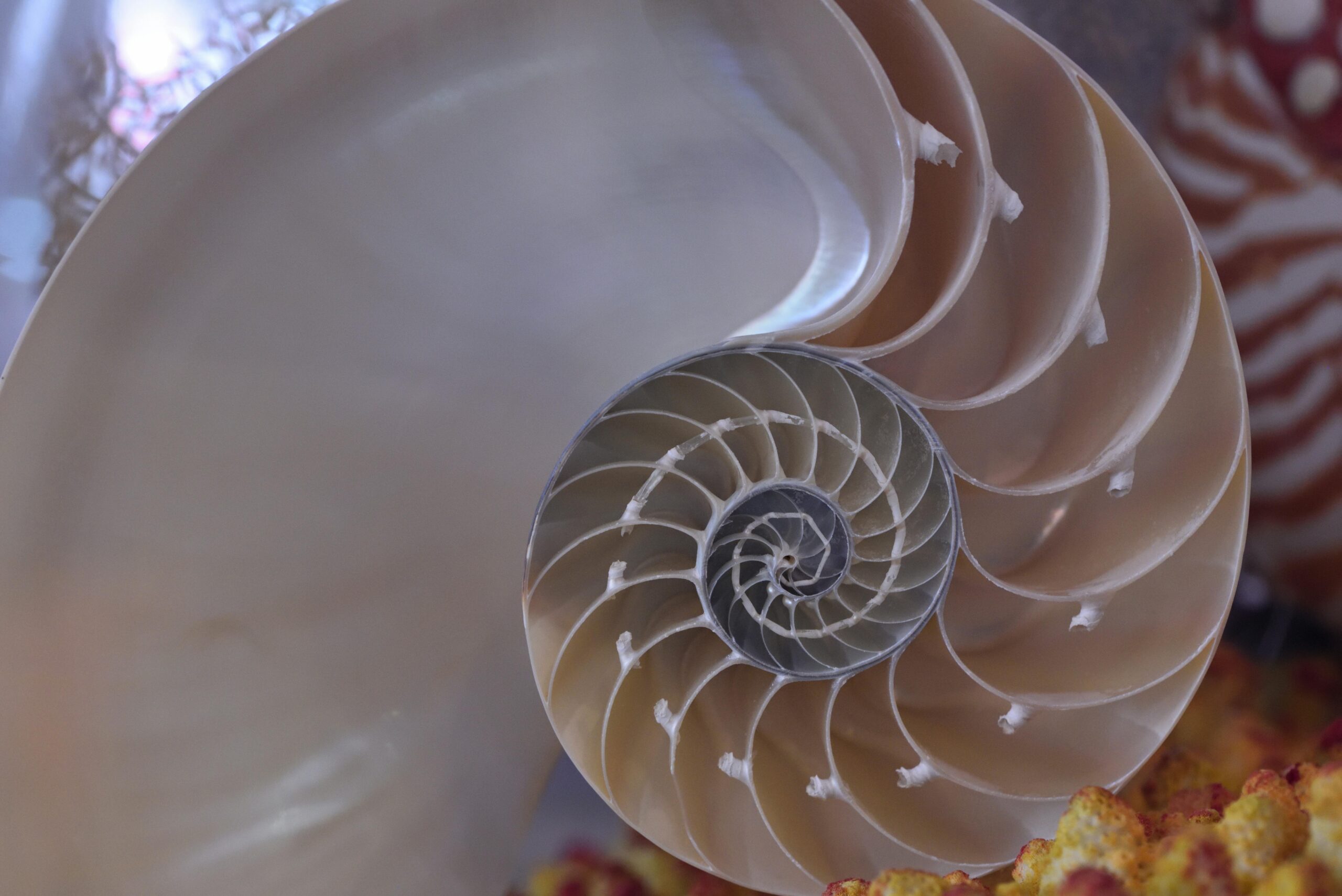
That of itself is fascinating to me, but when you look outside you see this golden spiral in things like sea shells, chameleon tails, hurricanes, spider webs, and ocean waves. You even see it in the shapes of galaxies in space. It’s incredible how many places we find this golden spiral!
Are you intrigued yet?
If we take this idea a bit further, we arrive at the Golden Ratio. This is also super interesting. Remember those rectangles I described earlier? The ones where the width and the length just happen to be two consecutive numbers in the Fibonacci sequence? Well, as those rectangles get larger and larger, the ratio between the length and the width gets closer and closer to the golden ratio, which is approximately 1.62. This ratio is known for being aesthetically pleasing in art and design, but it’s also found all over the natural world, including in the human form. This is also worth a little internet rabbit hole 🙂
There’s so much more to dive into…I think I could probably talk for hours about how math shows up in nature. I’m going to stop here for today, though, and make this part one of a series. I don’t want to give you so much information that it feels overwhelming to think about. Although, things that bring awe can often feel like that, can’t they?
So, I’ll close this post with a couple of thoughts. One, as we’ve talked about in previous posts,
if you are noticing these kinds of patterns I’ve described here when you are out in the world, you are a math person.
And two, if anything I’ve said here today has your brain itching to know more, go find out more. One simple search of Fibonacci or math in nature will lead you to all of these ideas and more. I’ll save some of the other ideas I want to share with you for another time.
If you enjoyed this discussion about a few ways math shows up in the natural world, please share this with someone who might like to learn a little bit about the ideas I’ve shared here. And if this post brought up some questions or thoughts for you and you’d like to share them, I invite you to comment here, message me over on Instagram, or send me an email. I’m the only one who reads your messages and emails and I respond to each one personally. Let’s continue this conversation!
On a side note…Did you hear I wrote a book? It’s launching October 1 and it’s for anyone who thought math was fine until the letters started showing up. It’s called “Algebra is Not the Enemy” and in it you’ll find clear and simple explanations for a couple of key concepts and a few clues to noticing where algebraic thinking shows up in your everyday life. You probably don’t even realize you’re using it and I promise it’s there! To be the first to know when it’s available and how to get it, head to onamission.bio/jennifermasonhardin and choose “I Wrote a book!”
Thank you for joining me today as we talked about the Fibonacci Sequence and how it shows up in nature. I hope this has inspired you to want to learn more. I’m Jennifer Mason Hardin and everywhere I look, I see math people just like you.