Are you a musician? Meaning, do you play a musical instrument?
I remember learning to play piano when I was a young child. I think I was five or six years old when I started lessons with the music director at the church we attended. She taught me how to sit properly on the piano bench, where to place my fingers on the keys, how to read the notes on the page, and which keys corresponded to those notes. Twinkle Twinkle Little Star and Mary Had a Little Lamb were among the first tunes I remember learning to pluck out on the piano. At home, I remember having to go down into the basement to practice for a certain amount of time each day. That’s where the piano was in our house.
What I didn’t realize at the time…I’m actually not sure when I did become aware of the connection…is how much math I was using when I played the piano and when I later learned to play the violin.
So, where is the math in music?
Everything is so interrelated, it’s hard to know where to begin. The kinds of notes on the page seems like as good a place as any, so let’s start there, okay?
Enter everyone’s favorite mathematical idea…fractions! Of course, I’m joking here about fractions being everyone’s favorite. They are actually the most feared concept among the students I’ve worked with over the years. But, that’s a topic for another day.
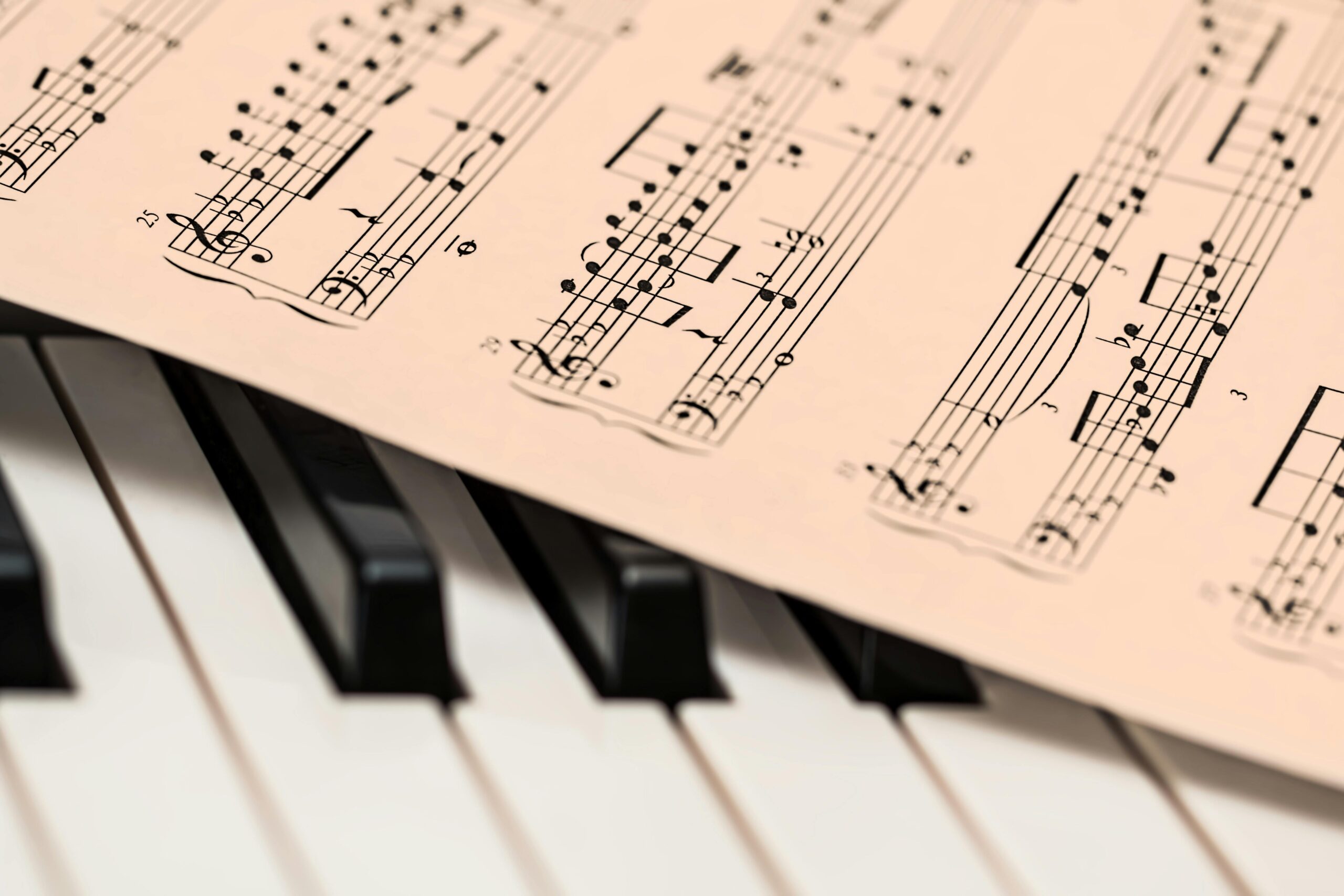
Back to music notes…If you read music, you are probably familiar with the idea of a whole note. When played, a whole note is held for four beats. The half note is held for two beats…it’s one half of a whole note. So two half notes get the same number of beats as a whole note. Are you following?
Then, there’s the quarter note, one fourth of a whole note, which gets held for one beat and an eighth note, one eighth of a whole note, which gets held for a half beat. I could keep going here, but you get the idea. The names of the notes are based on the fraction of a whole note they represent.
But wait, there’s more. Always, right?
A time signature is also kind of like a fraction. A time signature contains two numbers, the one on top tells you how many beats in a measure and the one on the bottom tells which note gets the beat. So in 4/4 time, there are 4 beats to a measure and the quarter note gets one beat. In 6/8 time, there are 6 beats in a measure and the eighth note gets one beat.
While the time signature doesn’t technically operate like a fraction, it does help you determine what fraction of a measure the beat note takes up. For example, in ¾ time…otherwise known as waltz time…there are three quarter note beats in a measure, so each quarter note is a third of the measure.
The point here is not to teach you about musical time, so if you don’t read or play music, and I just lost you, let it go. It’s enough to know that a time signature, and what it tells us about a musical piece, is related to the idea of a fraction.
But wait, there’s even more. Well, sort of…
You know how when you play two or three notes together, sometimes it sounds pleasant and sometimes it makes you cringe? I’m no music theory expert, so I don’t have a solid understanding of chords, but I do know that each musical tone, like middle C or high E, vibrates at a specific frequency. When you play two or more notes at the same time, the ratio of those frequencies is either pleasing to hear or sounds like a train wreck. Changing one note in a chord can change the entire sound because the ratio between the tone frequencies changes. Ratios are related to fractions, and are definitely a mathematical idea. Musicians even use terms like major third and perfect fifth when talking about chords.
That’s definitely a rabbit hole I could explore for a while. The mathematical connections in music are so fascinating to me!
Moving on to something a little less technical…let’s talk about rhythm and speed. Being able to keep a steady beat, maintaining a consistent rhythm, is mathematical in nature. If the guy playing the bass speeds up or slows down in tempo, everyone else must follow suit to keep the song going. We’ve all heard a modified version of our favorite song and noticed when the rhythm is different than the original. That same song played slowly has a very different vibe than when its tempo is fast, right?
When I taught littles…when I say littles, I mean 4-year olds and first graders…we used to play a game called “Cookie Jar.” We sat in a circle and started a beat by tapping our hands on our legs and then clapping. Tap, clap, tap, clap…Once we had that rhythm going, we’d say a rhyme about someone stealing cookies from the cookie jar. It was a fun time and usually ended in a lot of giggling, especially when someone tried a tempo that was too fast or too slow, which made it memorable for the kiddos. Just as importantly, though, it gave them practice at keeping time…both with the physical rhythm of the tap, clap, and with their words. This game also gave them practice continuing a pattern.
And there it is. Haven’t I told you everything in math comes back to patterns?
Here’s the most basic connection between music and math. Patterns.
The beat and rhythm we just talked about is a pattern. But so is the key a song is played in. So is the chorus of your favorite song. When you are able to “name that tune” in just a few notes, you are recognizing the pattern of the music. Scales, chords, bass lines, the different parts played by sections of the same orchestra or marching band, are all patterns. When these patterns get played in a certain way, we recognize them as familiar songs.
If you haven’t guessed it by now, here’s the point: There are many connections between music and math, many more than I’ve discussed here, so if you play a musical instrument, including your voice, you are most definitely a math person.
And, if you don’t read music, if you are someone who plays by ear, I would argue your connection to math when playing music is even stronger. Because even though you aren’t necessarily thinking mathematically, you are intuitively matching tone, harmony, and frequency, tempo, rhythm, and pattern. That means the “math” you are using is so embedded in you that it just comes naturally, without you even having to think about it.
So, here we are. Musicians, I’m asking you to pay attention. To notice where math comes into your music playing practice. When you find yourself noticing tempo, the ratios in your chords, the timing of the notes in a measure, or memorizing a song, remind yourself you are using math and celebrate that this makes you a math person!
If you enjoyed this discussion about some of the math related to playing musical instruments, please share it with someone who needs to hear what I’ve said here. Maybe you can work together to remind each other you really are math people when you aren’t feeling like you are.
I would love nothing more than to continue this conversation! Send me your thoughts and questions by commenting below, messaging me on Instagram, or emailing me. It’s just me on the other side of it all, and I truly can’t wait to hear from you. And, if you’d rather listen to these posts on the go, be sure to check out the podcast!
Did I mention I’m writing a book called Algebra is Not the Enemy? It will launch October 1! This book briefly breaks down a few foundational concepts so you can see what’s really happening, dives into growth mindset, and reveals how you use algebraic thinking more than you realize. So you can start noticing when you are using it and start shifting your view of algebra and of yourself. If you’d like to be the first to know when it’s available, go to onamission.bio/jennifermasonhardin and choose “I wrote a book!” to get on the list.
Talk to you soon!