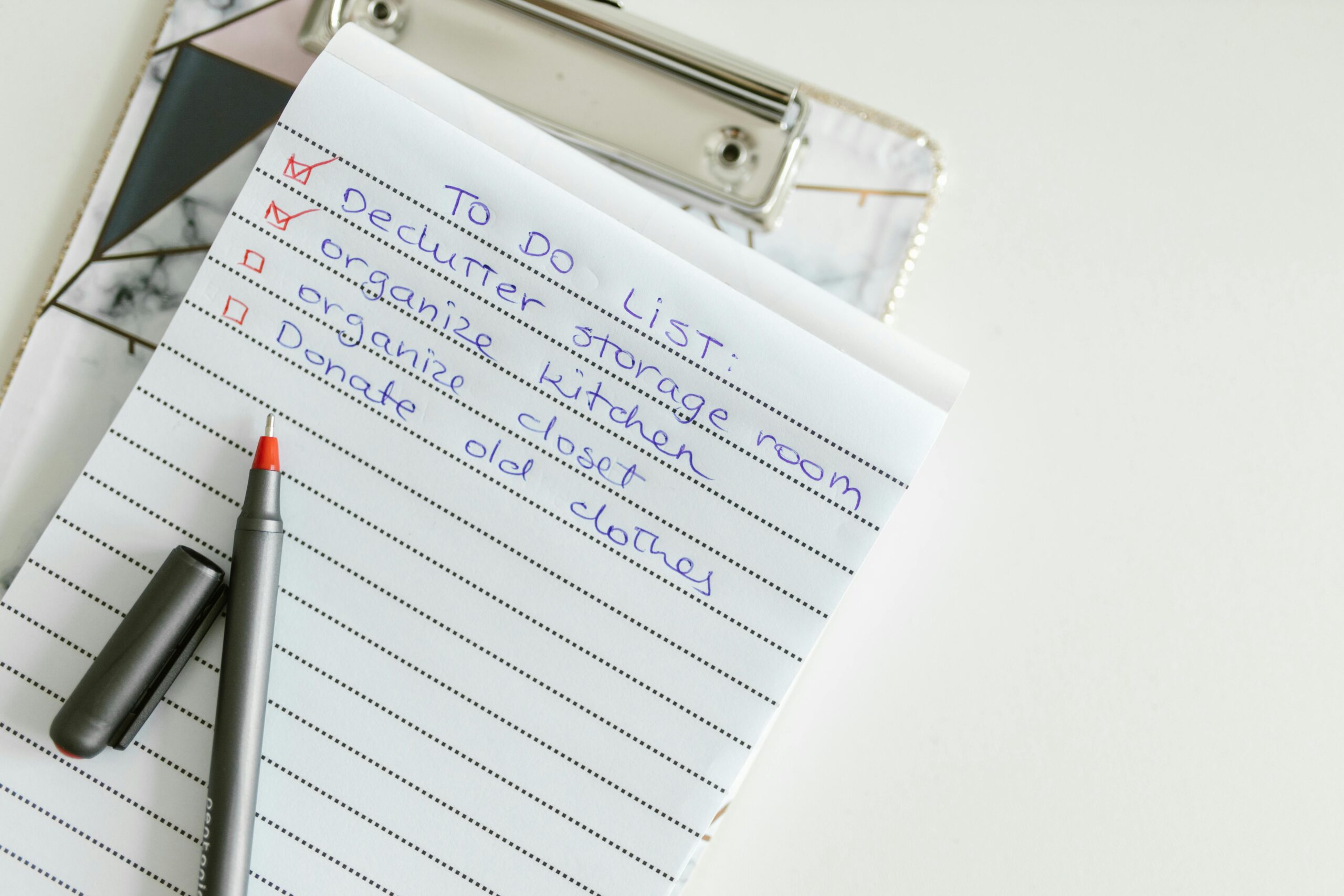
If you are anything like me, you make endless lists, mostly of things that need to get done. I love a good list for a few reasons:
- Writing down everything I need to do gets it all outside of my head so I can focus on actually getting things done;
- Having a list I can refer to reduces the chances I’ll forget something and I can add to the list as things pop into my head; and
- I find crossing things off the list immensely satisfying.
Have you ever written something on your list that you did before you made the list just so you can cross it off? Tell me I’m not alone here!
Would you be surprised to know your to-do list has mathematical connections? Let’s dive into what’s involved.
I don’t know about you, but when I make a list it’s really just a mind dump of all the things I want to do or that need to be completed by a certain day or time. When I’m on summer break, for example, I usually make a list of all the things I want to do before I have to return to the office the following semester. I don’t usually put them in any order, but I do sometimes categorize certain tasks and activities either as I am writing them down or later when I create a cleaned up version of the list. I might have a “Home” category for tasks and projects I want to do in my house, like paint the cabinets or declutter a closet or mulch the flowerbeds. Maybe I have an “Adventure” category for things like hiking or heading to the beach. I sometimes have a “Me” category for things I like to do…reading, sitting in the sun, painting my toenails, working puzzles.
Sorting objects by a certain characteristic is one of the first math skills we learn as children. At some point early in your life, you were probably given a collection of shapes or objects and asked to group them in different ways…by color, by shape, by size. As you got older, you learned to apply this concept to other things like numbers, words, ideas, historical events, book and movie genres, and more. Sorting the tasks on your to-do list is an extension of this, so it is by nature a mathematical task.
Of course, not every list gets sorted like this, so are you wondering if there’s more? Spoiler…there is.
Once you have a list of things you want or need to do, you must decide where to begin. There are times when I’ve just started at the top and worked my way down the list, but it rarely happens this way for me. Most often, and I bet this is true for you, too, I scan the list and decide what’s most important at that particular time. I prioritize based on any number of factors, but usually I start with the most pressing task. The thing that needs to be done first…because other tasks depend on that one being completed…or the one that has the soonest deadline. Prioritizing is kind of like a ranking system. Putting things in order based on a particular characteristic.
When we first learn to count, we learn to order the numbers in sequence. Later, we learn ordinals…what comes first, second, third, and so on. When I taught littles, I would sometimes ask them to line up according to a certain attribute. Maybe that was height, or birth month, or alphabetically by first name. Or I’d give them each a number or a letter and ask them to put themselves in order. Ordering, or sequencing, is a math skill, so when you prioritize your task list, you are using your mathematical brain to put those tasks in a particular order, based on what attribute is most important to you.
There are times when I look at my list and I know I only have a certain amount of time before I have to head to an appointment or before it’s time to cook dinner. In these cases, I scan my list for something that I know I can complete in the amount of time I have. When you do this, you are estimating how long something will take and comparing it to the amount of time you have to complete it. That helps you decide which task to pick. Estimation and comparison are math skills that are essential to our lives, meaning you use them every single day…If you are interested in a deeper dive of these two ideas, check out the posts Math is Close Enough and Math is Comparison to see how you estimate and compare on a daily basis.
Each time you complete a task, you go back to your list and start the process again. Evaluating, ranking, and choosing what to do next based on what’s most important to you at the time. It’s kind of an algorithm, or pattern, you generally follow. Well, of course it comes back to patterns, right? Sometimes, we call it a system or a process…those are just different terms for a pattern. We’ve discussed many times how all of math is essentially a study of patterns, so here is the most basic connection of all. When you go through this process of creating a list and completing the tasks, you are definitely using the math part of your brain.
There’s one more idea I want to talk about here. Sometimes, especially if the tasks on my list are work related, or if I want to be intentional about the time I devote to them, I’ll transfer them into my planner. I either write them at a specific time in my physical planner or I’ll enter them into the calendar or a reminder app on my phone. Sometimes, I even do both just to keep myself accountable and to reduce the chances I’ll either forget or choose to brush off the task.
Do you ever do this, too?
Working with calendars and schedules involves organizing, prioritizing, estimating, timing…all the things…so when you add your to-do list to your daily or weekly or monthly planner or calendar, you are using mathematical skills in the process.
To recap: creating a to-do list and completing the items on it involves mathematical ideas like sorting, organizing, sequencing, estimating, and scheduling, so if you are someone who uses tasks lists, you are absolutely a math person.
Here’s the thing. Most of us probably do all of this without even really thinking about it. It’s kind of automatic for you to make a list, prioritize it and choose what to work on, so you likely aren’t thinking about the processes involved. That is one reason I think you don’t consider yourself a math person. Because you’ve been doing these things for so long you don’t even have to think about them, so you really aren’t aware of the mathematical connections behind your actions.
Hopefully, this episode has given you some insights into how you are using your math brain every day…even when you aren’t thinking about math. Maybe you’ll even look at your to-do list a little differently from now on. When you do, take a moment to appreciate the math behind the list and pat yourself on the back for using your math brain. As we discussed in the last post, all it takes to be a math person is to use math in some way. That doesn’t necessarily have to involve numbers or calculating or determining the value of “x.”
Speaking of that elusive “x,” I’m writing a book that explains a few key concepts from algebra, so you can more easily see what’s happening, discusses growth mindset, and describes how you use algebraic thinking more than you realize. It’s called “Algebra is Not the Enemy” and it will be ready to launch on October 1. It’s great for students who are having difficulty with the basics and it’s also great for anyone who thought math was great until letters started getting mixed up with numbers. If you’d like to be the first to know when it’s available, go to onamission.bio/jennifermasonhardin and choose “I wrote a book!” to get on the list.
Here’s the big takeaway from today.
If you create to-do lists and use those lists to get things done, you are using more math than you realize. So, using a to-do list makes you a math person.
To continue this conversation, send me your thoughts and questions by commenting here on this post, messaging me on Instagram, or emailing me. It’s just me on the other side of it all, and I can’t wait to hear from you!
Until next time. I’m Jennifer Mason Hardin and everywhere I look, I see math people just like you.