It is no secret that the only thing I truly enjoy about food preparation is the eating part. I love to eat all kinds of foods from all around the world, but I don’t love the cooking part. Not even a little. It’s one of those areas of my life where I don’t necessarily exhibit a growth mindset. I cook meals from scratch because, well, we have to eat and I’m also leading a wellness focused lifestyle, but it’s not something I do because I love it or because I’m particularly good at it. I’m sure I could focus a few months on really learning some good techniques and perfecting a few recipes to keep in the rotation. The truth is, it isn’t all that important to me at this point in my life.
What I do know is there are people who are gifted in this area. Maybe you are one of them. You love to prepare meals for yourself and others. You like to experiment with new recipes and flavors. You enjoy cooking for a few or for a crowd. Even if this doesn’t sound like you, you have to eat, too, right? So, if you cook or bake at all, this episode is for you.
Because, whether you realize it or not, there’s a whole lotta math in cooking and baking.
So, if you are someone who prepares food, for yourself or for others, you are most definitely a math person.
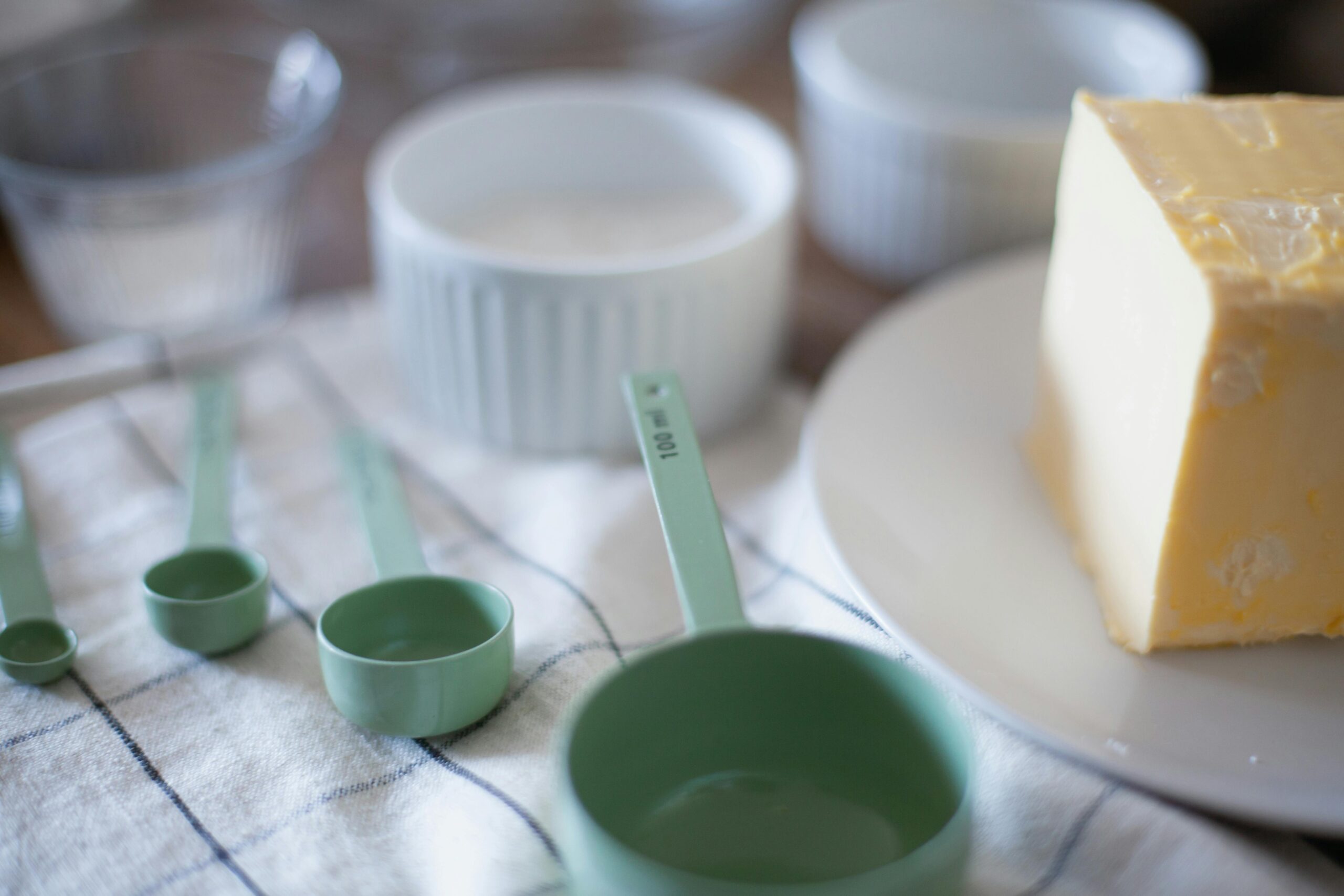
Let’s start with what might be an obvious connection…measuring. If you are using recipes for your favorite dishes and desserts, you need a certain amount of each ingredient. Sometimes, precision isn’t necessary. If you only have a teaspoon of garlic left and the recipe calls for two, your final result won’t be a disaster. For other things, exactness is important and if you leave out an ingredient or use too much or too little, things might not turn out like you expect. Whatever you use to measure…cups, spoons, or a scale, even “eyeballing” it, you are using a mathematical idea…measurement…to create your dish.
There’s something deeper going on here, though.
Many recipes call for specific amounts of each ingredient because ratios are important. If you swap the amounts for salt and sugar in your favorite cookies, you will get a very different outcome than you were hoping for. Why? Because the ratio is off. There is too much salt in relation to the amount of sugar. And you’ll definitely notice the difference in how that cookie tastes.
I remember one time, when my family traveled a few states away to visit my grandmother, she really wanted to cook for all of us. She spent time in the kitchen preparing a meal and when we all sat down to eat, the first bite was a bit shocking. She had either misread the amount of a certain spice or she accidentally used the wrong size measuring spoon. She unintentionally changed the ratio of spices in the dish which made that one overpower the others.
Has that ever happened to you?
Ratios also come into play when you are modifying a recipe to make more or fewer servings. If you double one ingredient, you have to double all the ingredients to maintain the proper ratios so your dish will still taste the same. If you’ve ever done something like that, you are most definitely a math person.
Temperature and cooking time are also measurments. Some recipes are more forgiving than others in this area, of course, but it’s important for our pans and ovens and foods to be at the right temperature and for that temperature to be maintained long enough for everything to cook properly. Meat thermometers, for example, allow us to know if what’s on the grill is a safe temperature to eat. Or maybe you’ve used a candy thermometer to help make delicious treats where precise temperature is an important part of the process.
Have you ever prepared multiple dishes to be ready at the same time? That’s like project management and requires some critical thinking and planning to get the job done. Those are skills that have their roots in logic…which is closely related to mathematical thinking.
If you are using a recipe, well, that’s a set of instructions to follow, or what we refer to as an algorithm…also a mathematical idea. For some recipes, doing steps out of order doesn’t make much of a difference, but if you try to bake your cake before adding in the dry ingredients, it probably won’t turn out like you expect.
If you like to wing it instead of following a specific recipe, there’s still a basic order of steps you follow and you probably taste along the way to make sure the flavors are to your liking. Remember those ratios I mentioned earlier? What you are really doing is testing them and deciding if you need to add a pinch more salt or a dash more chili powder to get the ratios just right. So, even though you aren’t thinking about the math, your taste buds are searching for the perfect flavor ratios.
What other math skills are hidden in food prep?
- Well, if you are cooking for a crowd, you’ll need to estimate how much food each person will eat so you know how much to prepare.
- Working with fractions (which are similar to ratios in some ways), both when creating your dish, but then also when you are serving. Like when you cut the cake into pieces that are roughly the same size.
- There’s spatial reasoning when choosing what size pan or baking dish to use, and the right size bowl for storing leftovers.
- If we include grocery shopping in the discussion, there’s budgeting and money and more ratios with prices per pound or ounce.
- Patterns. There are always patterns. A recipe is a kind of pattern. But so is how you prepare your sandwich. So…even if you aren’t cooking, you are still using math.
- And, there’s bound to be some problem solving in there, too. You know, what to do when you miscalculated the time it would take to cook the turkey or when the kind of cheese you used for the mac and cheese sauce doesn’t melt very well…that one may or may not have happened to me recently.
What am I really saying here?
If all it takes to be a math person is to interact with mathematical ideas in some way, and you are involved in cooking and baking in any way, you, my friend, are a math person.
So, that was a lot of words to explain how cooking a meal makes you a math person. Hopefully, this discussion has given you something to think about and the next time (and every time after that) you cook a meal or prepare some food…even packing a lunchbox…you’ll remember what you read here. You’ll notice the math you are using and then your brain will start realizing you are a math person after all. And won’t it be fun to see what happens after that, when you start to believe math is for you.
Just think about the opportunities you’ll consider when you believe in yourself a little bit more.
I’d love to hear your thoughts—whether it’s a question, a story, or an “aha!” moment you had while reading. You can comment on this post, join the conversation on Instagram, or send me a quick message or email. And if you know someone who might enjoy this, please share this with them so they can join the conversation, too. If you rather listen in, you can check out the podcast.
Talk to you soon!