My husband I recently visited Hawai’i as a celebration of 30 years of marriage. We have been trying to get there to celebrate milestone anniversaries for 20 years and this year we finally made it happen! There’s a whole lot I could say about the trip, but I’ll stay on topic here and give you the run down on where the math shows up in your vacation planning. After all, if you plan trips or vacations, you are a math person 🙂
There are probably countless ways you use math to plan your trip. Here’s are a few thoughts on four parts of the process and the math that’s involved.
BUDGETING
I don’t know very many people who just take off on a vacation without thinking about the cost. So, I’m guessing you started with a number in your head that represented the amount of money you were willing to spend on your trip. In case you aren’t aware, that number is called your budget and your goal is to find a way to fit in all the things…transportation costs, lodging costs, activities costs…while staying around that number. Sometimes, that’s pretty easy. Sometimes, it isn’t and you have to make concessions or adjust your number.
So, what math is involved in creating a budget for your trip (or any kind of budget)? You might think basic calculations…like addition and subtraction…is really it. It’s true that’s part of it. There’s also understanding part-whole relationships, percentages, and even algebraic thinking. There also can be some problem solving thrown in there if you have difficulty finding what meets your needs at a price that keeps you within budget.
SCHEDULING
Dates and times become pretty important when you are planning a trip. Your travel dates need to line up with your hotel reservations and your travel times need to account for layovers, if you are flying, and traffic and stretch breaks, if you are driving. If you are reserving tickets for attractions or events, you’ll need to factor in the timing and scheduling for these activities as well.
Of course, you’ll need calendar skills and time management skills for all of this. Would you be surprised to know that this also requires algebraic thinking? It also involves organization and logical thinking, both of which are mathematical processes.
PACKING
Are you aware there is mathematical thinking involved throughout the entire packing process? First, you have to decide what size suitcase best fits your needs for your trip. That’s measurement and estimation. Then, you have to decide what’s really important to take and what can be left at home. You’ll also need to make sure you have enough outfits to last the length of your trip and make sure they are appropriate for the weather at your destination and the activities you’ll participate in. All of this requires critical and logical thinking.
There’s more, though.
When you put things in your suitcase, you might organize them in such a way that helps you make sure you have everything you need and that you can find what you need easily. Putting toiletries in a bag together, for example. Sometimes, it’s also kind of like a puzzle when you try to figure out how to place things in your bag (or in your trunk) so they all fit. Categorizing and organizing both are mathematical in nature. You are also using a bit of visual-spatial reasoning. You might even be thinking about weight distribution so you aren’t lugging around a top heavy bag or so the weight in your car is evenly balanced. Or, maybe you are making sure your bag is within the weight limits if you are checking it for a flight. That’s measurement again.
So, when you are preparing to pack, organizing your luggage, and packing your trunk, you are thinking like a math person.
NAVIGATION
When we head out on a trip, we need to know where we are going, right? You need to find your way to the airport or train station. You have to find your gate or your route to your destination. Once you get where you are going, you need to find where you are staying, where to eat, the activities you’ll do. All of that requires navigation.
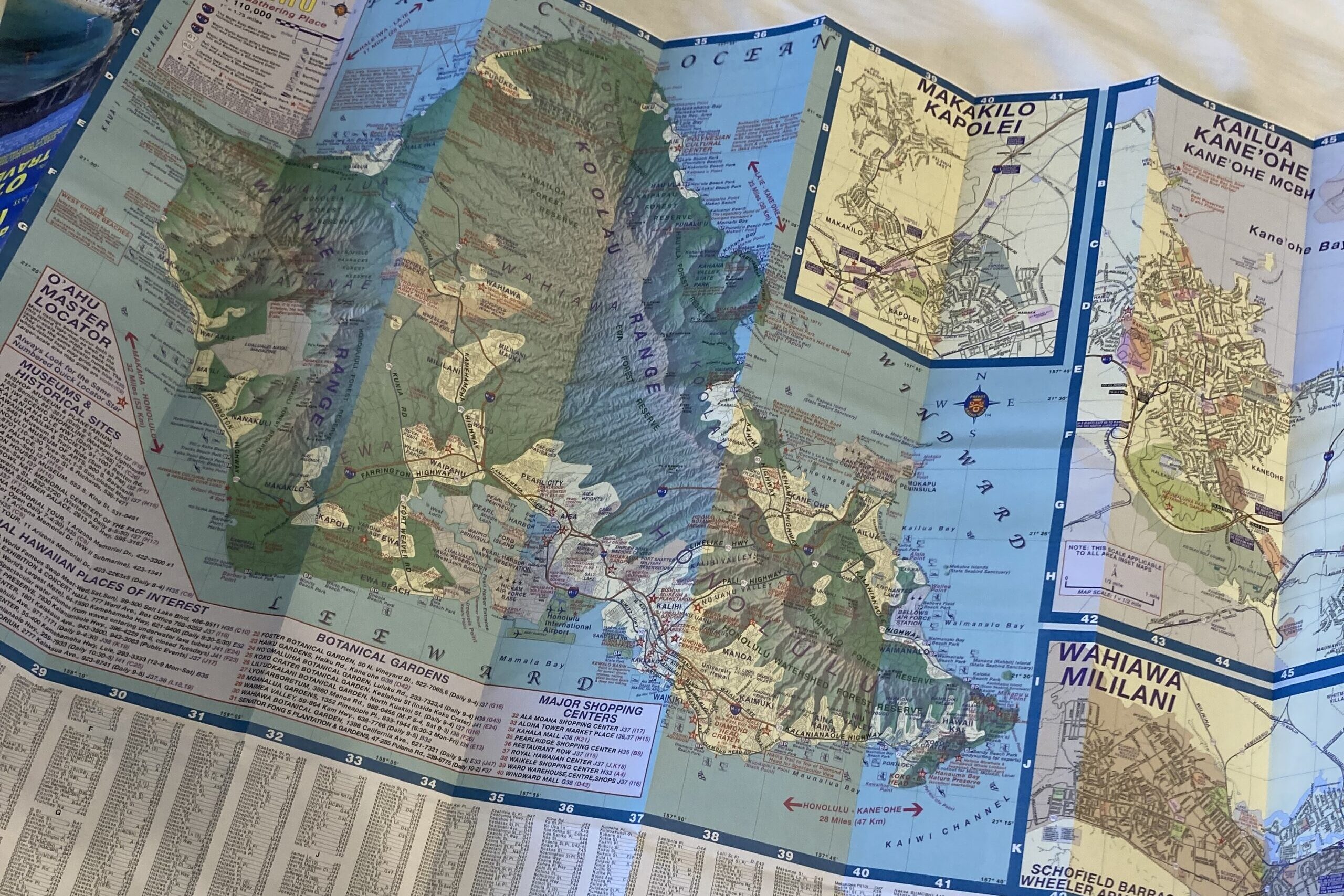
You’ll use signs to help you find things like your gate or the right highway to turn on. You might use a map to find the pool at your resort or your favorite store at the shopping center. You might even enter an address into an app on your phone. No matter what tools you are using to help you find your way, your are using mathematical thinking to get you there. Following directions, whether by signs or by listening to your GPS, is a mathematical skill. Reading a map requires visual-spatial reasoning and, if you are using an old school road map like the one in the picture above, you might even be using some grid and graph knowledge to find both your location and where you are going. Throughout the navigation process, you are also using problem solving skills and orienting yourself to your surroundings by noticing landmarks to make sure you are headed in the right direction.
All of this requires a certain level of mathematical and logical thinking. You know what that means, right?
You are a math person.
We’ve talked before about what’s necessary in order for you to shift your mindset around math and your relationship to it. If you are serious about making this shift, you’ll need to provide your brain with a ton of evidence that you are a math person. What do I mean by this? Well, for starters, whenever you find yourself doing any of the things we’ve discussed here…budgeting, scheduling, packing, navigating…even if they aren’t related to a vacation or a trip, stop and acknowledge the mathematical thinking required. You can even say something to yourself like, “I just planned a trip that keeps me on budget. That means I’m a math person!” or “I just organized my suitcase. I’m a math person!”
Keep doing this consistently and one day you might just wake up with a different belief about yourself. You’ll see yourself as the math person you really are.
Does any of this resonate with you? Does it bring up questions or make you think of a way you used math during your last vacation? I’d love to hear all about your thoughts! Take a minute to shoot me an email, comment on a post or send me a message on Instagram and let’s continue the conversation! If you’d like to hear this information in an audio format, be sure to check out Episode 8 of I See Math People on Spotify or Apple.